
Užupis guide
Explore the self-declared republic: constitution, the Angel, river bridges, galleries, cafés and April 1 spirit.
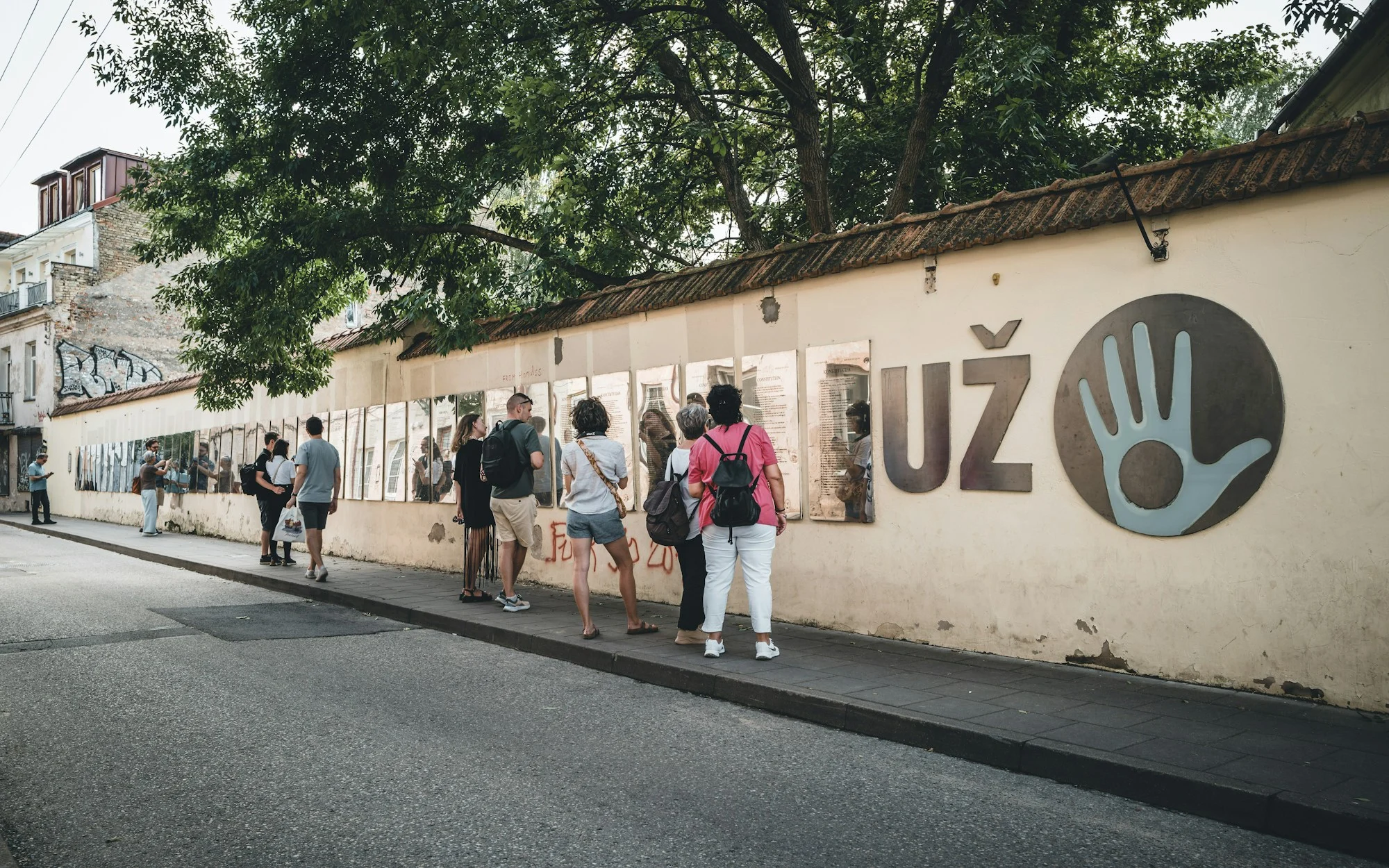
- ✓Across the Vilnia from the Old Town, Užupis is a self-declared 'republic' of artists with its own constitution, flag, anthem, president and a tongue-in-cheek Independence Day every April 1.
- ✓It's tiny and walkable — galleries, studios, courtyard cafés, street art and river-edge benches packed into a few cobbled streets.
- ✓The must-sees are the Angel of Užupis, the wall of the Užupis Constitution on Paupio Street, and the bridges over the Vilnia.
- ✓Founded in 1997, the republic is half art project, half genuine neighbourhood — quirky on the surface, gentrifying and creative underneath.
- ✓Free to wander any time; April 1 is the big day, when border guards 'stamp' passports and the whole quarter throws a party.
A republic across the river
Cross one of the little bridges over the Vilnia river east of the Old Town and you leave Vilnius for the Republic of Užupis. The name simply means 'the other side of the river', and for decades this was a poor, slightly rough quarter of crumbling houses and cheap rents — which is exactly why artists moved in. On 1 April 1997 they made it official, sort of, declaring an independent republic with its own flag (a hand with a hole in the palm, on a coloured field that changes with the seasons), an anthem, a cabinet of ministers, a president, and even a small symbolic army that was promptly retired.
The whole thing began as something between an April Fools' joke and a manifesto, and that double nature is still the point. Užupis is not a theme park; it's a real neighbourhood where people live and work, where galleries share walls with apartments and a converted factory hums with studios. But it wears its imagination openly — in the sculptures, the constitution on the wall, the painted doorways and the spirit of cheerful self-invention that the founders, led by the poet and film-maker Romas Lileikis, baked into it from the start.
You can 'do' the headline sights in an hour, but Užupis rewards slowness. Get a coffee, sit by the river where the Vilnia tumbles over a little weir, read a few articles of the constitution, and let the place's odd, gentle logic settle on you. It is, by some distance, the most charming hour in Vilnius.
A word on geography, because it shapes the visit. Užupis is small — a wedge of land hemmed in by the Vilnia on most sides and rising up the slope toward Three Crosses Hill behind. There's no single main avenue; instead a handful of cobbled streets fan out from the central square and tangle into quiet residential lanes. That compactness is part of its appeal: you can wander the whole quarter in a couple of hours and never feel you're walking in circles, even though you probably are. Crossing one of the bridges back into the Old Town takes only a minute or two, so it's easy to dip in and out as part of a wider day.
The Angel of Užupis
The symbol of the republic is a bronze angel standing on a tall column in the small triangular plaza at the heart of the quarter — Angel of Užupis Square. The angel blows a trumpet, proclaiming, as the locals like to say, the rebirth of the area and the freedom of artistic creation. Sculpted by Romas Vilčiauskas, it was hoisted onto its 8.5-metre pillar on 1 April 2002, marking the republic's fifth anniversary, and it has been the district's mascot ever since.
There's a typically Užupis backstory: the sculpture wasn't ready in time for an earlier planned unveiling, so for a while a large egg sat on the column instead — and the legend grew that the angel hatched from that egg. Before the angel, the column carried that egg as a placeholder; the egg later found a home elsewhere in the city. It's the kind of myth the republic spins about itself, half-true and wholly charming.
The angel is more than a mascot; it's a statement of intent. With its raised trumpet it 'announces' the rebirth of a once-derelict quarter and the freedom of creative life that the founders wanted to protect here. Locals gather beneath it for the republic's ceremonies, and it serves as the unofficial centre of gravity for the whole neighbourhood — the spot people mean when they say 'meet me in Užupis'.
The square around the angel is the natural meeting point and the best spot to get your bearings: cafés spill onto the cobbles, the constitution wall is a short walk away on Paupio Street, and the river is just downhill.
- Bronze trumpeting angel by Romas Vilčiauskas, raised 1 April 2002 on an 8.5 m column.
- Stands in the central plaza, the republic's natural meeting point.
- The 'egg' legend: a placeholder egg stood here first, so the angel 'hatched'.
- Free and always visible; lovely at dusk when the square lights up.
The bronze angel that watches over the republic.
Užupis ConstitutionThe wall of plaques a short walk from the angel.
Map pins
Map data © OpenStreetMap contributors · Tiles © OpenFreeMap
The Constitution on the wall
A few steps from the angel, on Paupio Street, a long wall is lined with mirror-finish metal plaques, each engraved with the 41 articles of the Constitution of the Republic of Užupis — and each plaque in a different language. Written in 1997 by Romas Lileikis and Tomas Čepaitis (reportedly in a single afternoon), the constitution is the republic's manifesto and its best joke at once. It has since been rendered into dozens of languages, with new plaques added over the years, so visitors can usually find their own tongue somewhere on the wall.
The articles range from the poetic to the absurd to the genuinely moving. 'Everyone has the right to be happy.' 'Everyone has the right to be unhappy.' 'A dog has the right to be a dog.' 'Everyone has the right to love.' 'Everyone has the right to die, but this is not an obligation.' Read a dozen of them in a row and you start to feel the republic's worldview: tolerant, gently anarchic, and quietly insistent that there's more than one way to live. It's the single most-quoted thing in Užupis and the reason many visitors come.
We've given the constitution its own page with the full context and the best photo angles; here it's enough to know it sits a two-minute stroll from the angel and is free to read at any hour.
Bridges, river and street art
Užupis is defined by its river. The Vilnia loops around the quarter, and the bridges that cross it are part of the experience. The main footbridge near the angel is hung, in warmer months, with padlocks left by couples, and railings along the water double as informal galleries. Below, the river drops over a small weir; in summer people dangle their feet over the edge, and there's even a quirky tradition of a 'mermaid' figure tucked into the embankment wall, said to lure visitors into staying in Užupis forever.
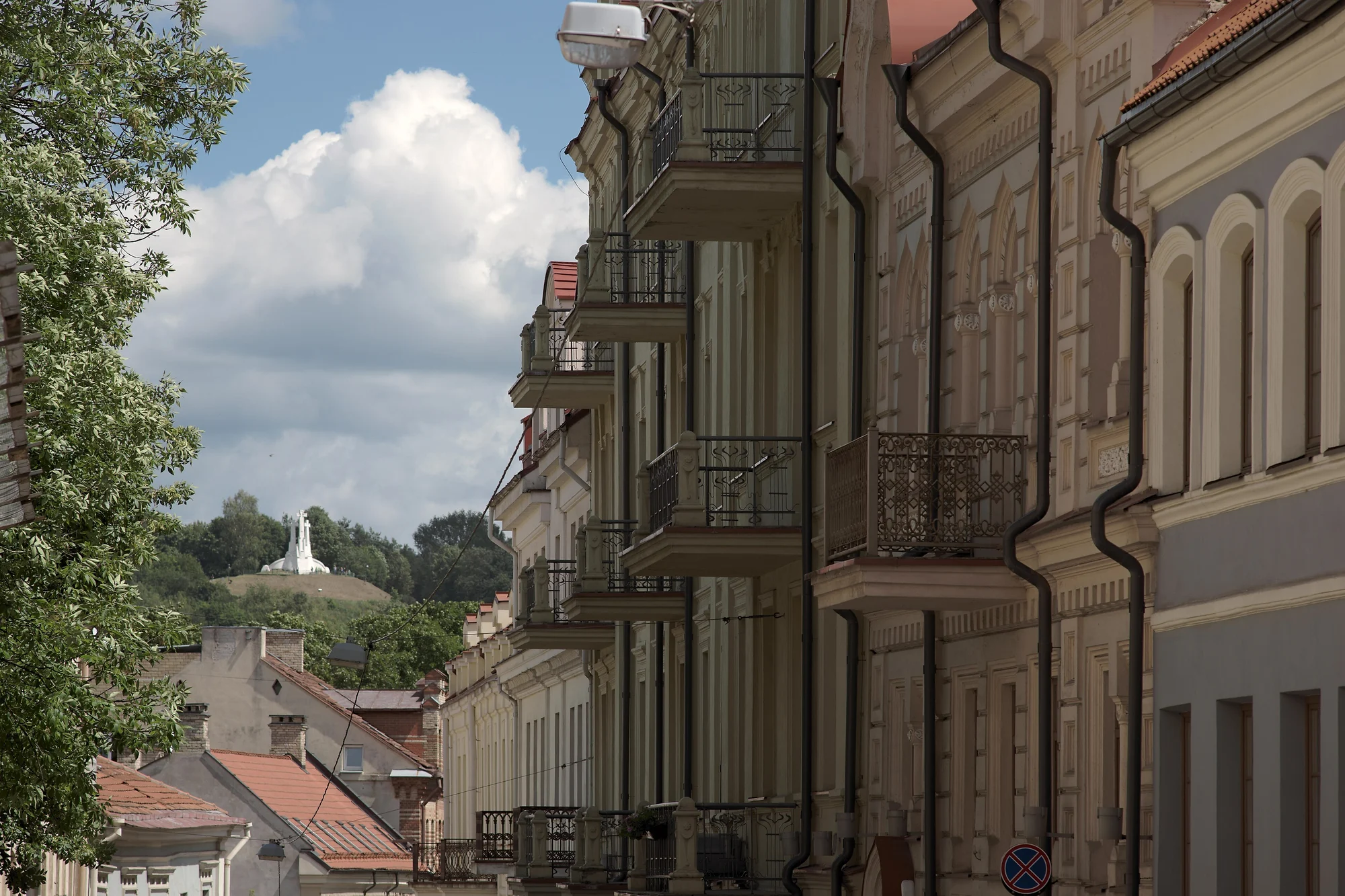
Wander off the main square and the street art begins. Painted doorways, mosaics, hidden sculptures, a 'Tibet Square' with prayer flags, courtyard installations and the open studios of working artists turn the side lanes into a slow treasure hunt. The vibe shifts from polished and café-lined near the bridges to scruffier and more experimental as you climb away from the water. There's no single route — half the pleasure is getting mildly lost.
The Vilnia bridges also make Užupis a brilliant pivot point. From here you can climb to Three Crosses Hill in minutes, drop back into the Old Town for the churches, or follow the river toward the regenerated Paupys district for more modern cafés and food.
- Vilnia footbridges — love padlocks, river views and the little weir below.
- The Užupis 'mermaid' in the embankment wall, with her own legend.
- Painted doors, mosaics, Tibet Square and open artist studios in the back lanes.
- A natural hub: minutes from Three Crosses Hill, the Old Town and Paupys.
Quirks, legends and things to look for
Half the joy of Užupis is in the details you stumble on rather than the marked sights, and the republic has stuffed itself with small surprises. Tibet Square, a little plaza decorated with prayer flags and a portrait of the Dalai Lama, expresses the quarter's long-standing solidarity with Tibet — the Dalai Lama has visited Vilnius, and Užupis declared its support in characteristically theatrical fashion. Look, too, for the swing hung over the river, the open-air piano sometimes left out for passers-by to play, and the rotating cast of temporary art installations that appear and vanish with the seasons.
The republic's mythology is everywhere if you know where to look. Beyond the angel and the constitution, there's the Užupis 'mermaid' set into the embankment below the main bridge, whose legend warns that anyone who meets her gaze will be lured into staying in the quarter forever. There are honorary 'embassies' of Užupis in cities around the world, an annual cast of ministers, and a currency and passport stamp that appear on the national day. None of it is quite serious, and all of it is part of a coherent, deadpan game the neighbourhood plays with itself and with visitors.
Because so much is unmarked and changeable, the best strategy is simply to leave the main square and wander the side lanes with your eyes open. Peer into courtyards (politely), follow a mural around a corner, push on a gallery door that's ajar. The republic rewards curiosity more than any guidebook checklist — the things you'll remember are usually the ones you found by accident.
- Tibet Square — prayer flags and the quarter's solidarity with Tibet.
- The river swing, the open-air piano and rotating temporary installations.
- The embankment 'mermaid' and her stay-forever legend.
- Honorary Užupis 'embassies' worldwide, plus the national-day currency and passport stamps.
Cafés, galleries and where to slow down
Užupis runs on coffee and conversation. Around the central square and along the riverbanks you'll find a cluster of cafés and small restaurants — places to nurse a flat white, eat a leisurely brunch, or settle in for a glass of wine as the light fades. The quarter has long been a magnet for creative types, and the menus and interiors tend to reflect that: design-forward, a little bohemian, rarely in a hurry. Spring and summer are the sweet spot, when tables move outside and the river-edge benches fill up.
It's also a genuine art district. The Užupis Art Incubator, housed in former industrial buildings, supports working artists and stages exhibitions; commercial galleries and craft studios are scattered through the lanes. Even a casual wander turns up open doors and 'come in' signs. If you're building a creative day, Užupis slots neatly alongside the MO Museum and the city's street-art trail.
Food in Užupis leans the same way as its art — independent, characterful and a little experimental rather than chain-driven. You'll find everything from a no-frills bakery and a cosy bistro to ambitious modern restaurants and the kind of small wine bars where the owner pours and chats. None of it is fast: this is a part of town built for lingering, where a coffee can become an afternoon and dinner runs long. If you want a recommendation tailored to your taste, our cafés and restaurants guides cover the standouts in and around the quarter.
Practically: there's no admission to the neighbourhood, no opening hours, and no single 'sight' you must pay for — it's a place to be in rather than tick off. Allow at least an hour, ideally two or three with a meal. Wear comfortable shoes for the cobbles, and if you can, time your visit for late afternoon into the evening, when the square glows and the cafés are at their best.
From slum to bohemia — a short history
To understand Užupis, it helps to know what it was. For much of the twentieth century 'the other side of the river' was a neglected, semi-derelict district — a place of crumbling pre-war houses, cheap rooms and a slightly dangerous reputation, home before the Second World War to a large Jewish population and, in the Soviet decades, to whoever could afford nothing better. That very neglect is what saved it: low rents and empty buildings drew artists, students and free spirits in the 1980s and 1990s, the same pattern that has remade run-down quarters in cities across Europe.
When those residents declared independence on 1 April 1997, they were both joking and staking a claim — a way of saying that this scruffy, creative corner had a character worth defending. In the years since, the republic has acquired its full apparatus of self-mythology: a flag, an anthem, a constitution, ambassadors in cities around the world, and an annual national day. Much of it is play, but the play has had real effects, knitting the community together and putting Užupis firmly on the map.
The engine of the district's art life is the Užupis Art Incubator (Užupio meno inkubatorius), housed in former industrial and residential buildings near the river. It provides studios and exhibition space to working artists and has helped make Užupis a genuine production centre for art and craft, not merely a backdrop. Around it cluster commercial galleries, ceramic and glass studios, and the open doors of makers happy to chat. It's this working-artist substance, beneath the whimsy, that keeps the neighbourhood feeling authentic.
Inevitably, success has changed Užupis. The same low rents and bohemian buzz that drew artists have, over two decades, drawn developers, boutique hotels and higher prices, and longtime residents debate — as in every gentrifying district — whether the republic is becoming a victim of its own charm. You'll see the tension on the ground: lovingly restored townhouses next to peeling facades, a smart wine bar a few doors from a ramshackle studio. It's worth keeping this in mind as a visitor. The most meaningful way to enjoy Užupis is to put money into the hands of the artists and small cafés that give it its character, rather than treating it purely as a free photo backdrop, so that the creative community the republic was built to protect can afford to stay.
Planning your visit
Užupis costs nothing to enter and keeps no hours — it's a neighbourhood, not an attraction — so you can drop in whenever suits your day. That said, timing changes the experience. Late afternoon into early evening is the sweet spot: the light softens on the cobbles, café terraces fill, and the square takes on a warm glow. Spring and summer are when the quarter is at its most alive, with outdoor tables, river-edge loungers and a steady drift of people; winter is quieter and more atmospheric, the bridges and lanes hushed under snow.
Getting there could not be simpler. From Cathedral Square it's about a ten-minute walk along the edge of the Old Town and across one of the Vilnia bridges; from St Anne's and the Bernardine Garden it's barely five. There's no need for transport, and in fact the cobbled, sometimes steep streets are best met on foot in comfortable shoes. Allow a minimum of an hour for the headline sights — the angel, the constitution, the bridges and a wander — and ideally two or three if you add a coffee, a gallery or a meal.
A short etiquette note: people live and work here, so keep noise down in the residential lanes, don't wander into private courtyards uninvited, and support the place you've come to enjoy by buying a coffee or a piece of art from the makers who give Užupis its soul. Do that, read a few articles of the constitution, and you'll leave understanding why so many visitors name this small republic across the river as their favourite part of the whole city.
- Free, open any time; best late afternoon into evening, liveliest in spring and summer.
- A 5–10 minute walk from Cathedral Square or St Anne's — no transport needed.
- Allow 1 hour minimum, 2–3 with a café, gallery or meal.
- It's a living neighbourhood — tread lightly and support local makers.
April 1 — Užupis Independence Day
If you can possibly time it, come on 1 April. Užupis Independence Day is the republic's national holiday and its biggest party: 'border guards' set up at the bridges to stamp visitors' passports with the Užupis seal, the local currency makes an appearance, the cabinet of ministers parades, beer flows, and the streets fill with music, art happenings and gleeful absurdity. For one day the joke is fully, joyfully real, and the whole quarter performs its independence with a straight face.
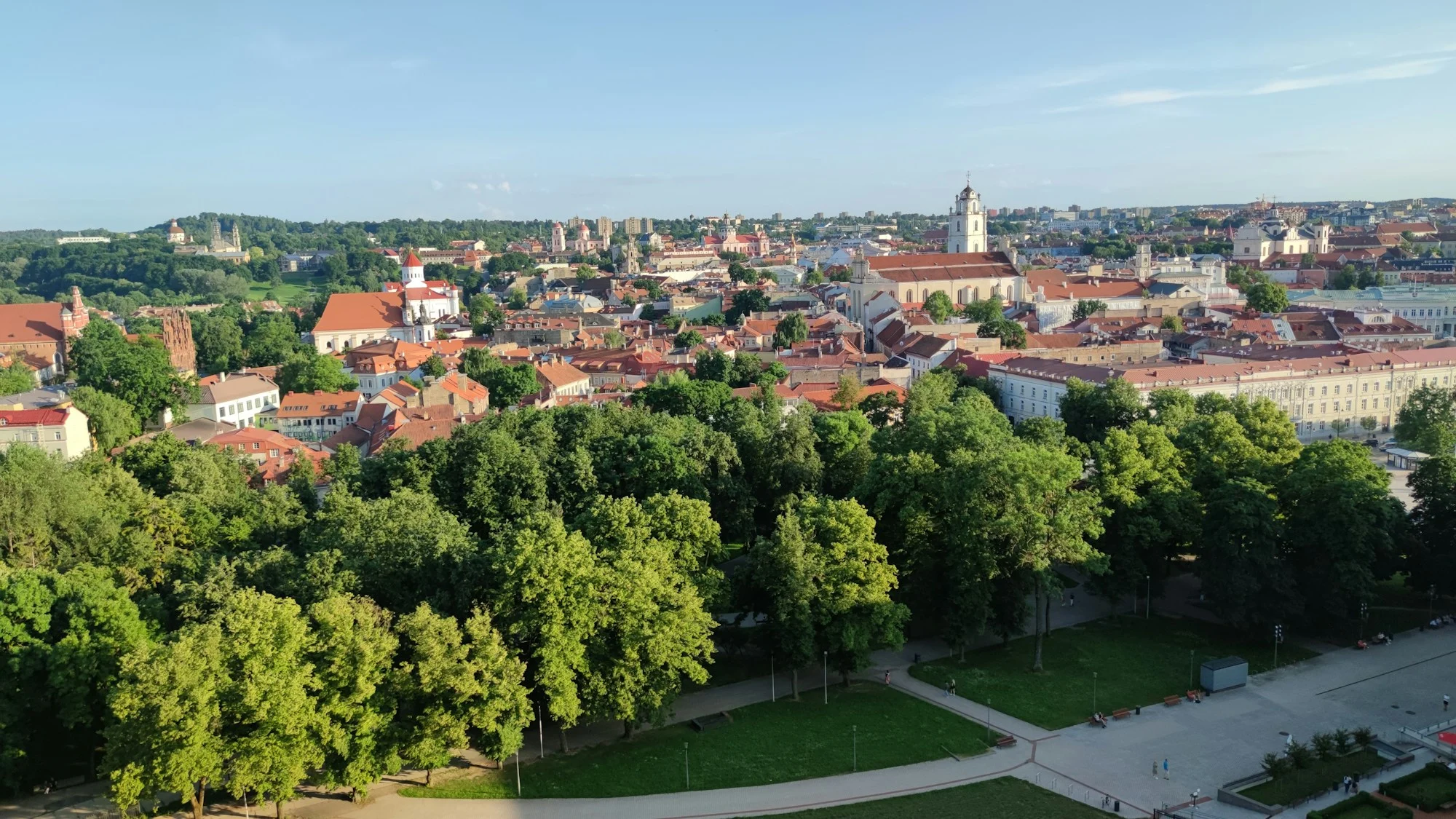
The rest of the year, Užupis is calmer but no less itself. The constitution stays on the wall, the angel keeps blowing its trumpet, the cafés keep pouring coffee, and the galleries keep their doors open. You don't need the festival to feel the spirit — but if you're a planner and the dates line up, April 1 in Užupis is one of the most distinctive experiences in the Baltics.
However you visit, treat the place with the same affection it shows the world. It's a living neighbourhood that has chosen to be playful; meet it halfway, read a few articles of its constitution, and you'll understand why so many travellers say Užupis was the part of Vilnius they fell for hardest.
- April 1: passport stamps at the bridges, the Užupis currency, parades and parties.
- The republic's flag changes colour with the four seasons.
- Off-season, all the sights — angel, constitution, river, galleries — remain free and open.
- A few hours minimum; an evening meal turns it into the highlight of a trip.
Related guides
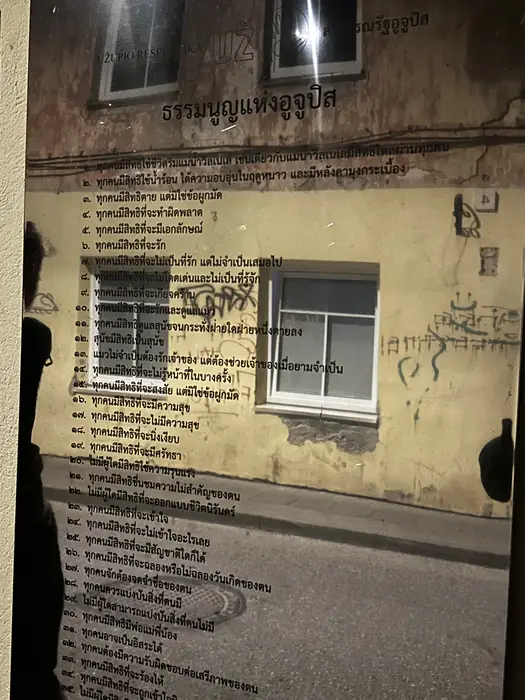
Užupis Constitution guide
Find and read the wall of constitutional plaques, with context, photos and respectful visiting notes.
Read guide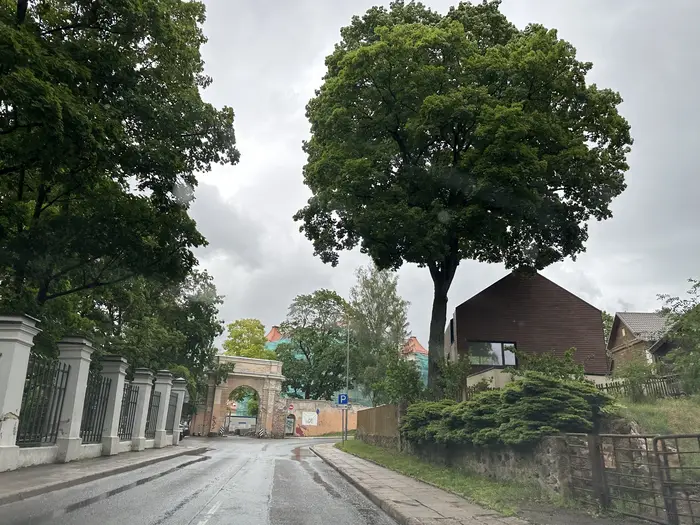
Angel of Užupis
The bronze angel that crowns the central square of Užupis — the symbol of Vilnius's self-declared bohemian 'republic' and one of the city's most-loved photo spots.
Read guide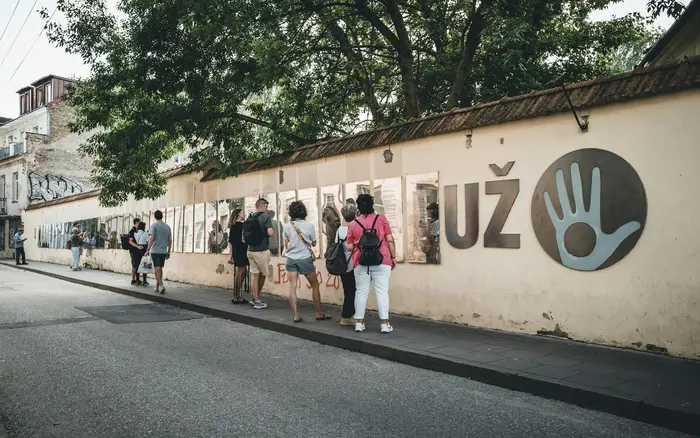
Užupis Neighborhood Guide
A guide to Užupis, Vilnius's self-declared bohemian 'republic' across the Vilnia: its tongue-in-cheek constitution, galleries and sculptures, café-and-wine-bar afternoons, and how to spend time in the city's artistic heart.
Read guide